Sunday, May 31

Bidding adieu


So the date has been finalized, June 11th  will be my last day. I finished my last experiment (ran a real time PCR experiment end of May). I am moving away from benchwork and basic science into hopefully a career in global health.

You see, two things happened over the course of these last few years during my postdoctoral years- on the positive side, my social mindedness was taking over my thoughts and driving me toward a path where I wanted to be directly involved in making people’s lives better, hence the Master of Public Health from Johns Hopkins (yes I did graduate people, this May in fact!). And two, a negative feeling with regards to biological research in general was setting in. I was starting to feel the pressure of “publish or perish” culture. This absolutely did not sit well with me especially since all I wanted to do was have fun doing science and that was getting harder and harder to do.

One positive and one a very negative feeling (I might elaborate a bit more when I am ready to spin it in a less negative tone): I am glad the positive one took over. I have finished my public health program and I have decided to move on into a global health career.

This decision has not been easy but it never will be especially since what I will be giving up is something that I have immensely enjoyed and something that is a part of who I was, who I am and who I will be. Now that I think about it: if there has been a constant in my life- that would be my love for biology.

As human beings, we are naturally curious and this curiosity is exactly what drives people into scientific pursuit; there is no better way to scratch that curiosity itch if you will. While I was always the nerdy curious kid, I never thought I would get to spend almost 15 years of my adult life (20 if you include my undergraduate years!) trying to figure out what goes within us, delving deeper and deeper within each of our cells.

Now for some cliches: All good things must come to an end; Change is the only constant thing (and any other that you can think of)

I do feel guilty about leaving all this behind- guilty because I am leaving behind what I know best; guilty because there are unfinished experiments that I am going to thrust on other people in the lab (of course there is no end to the experiments); guilty because I would not be earning for a little while and have to rely on my spouse for finances. But beyond all this contrition is the excitement, excitement about having to learn things that are out of my comfort zone (keeps my mind sharp a.k.a  terrifying!), excitement about getting to travel and volunteering with some cool organizations, excitement about the challenging opportunities that might come my way- I am ready as ever as I will be.

I am fortunate that I have had excellent scientific/academic mentors. I am also extremely lucky to have spent all these years in different labs with lab members who have become much more than colleagues.

All in all, in the end, I am glad and truly grateful that I was in control of this change, that when the time was right, I was able to make a decision- such things rarely happen in my life. Usually I am just thrown into situations and I hate making decisions!

Indeed, come June 11th, I will be hanging up my lab coat, for now anyway :)

Gandhi said “Be the change that you wish to see in the world" and I hope to achieve exactly that even in some miniscule form. 

Wish me luck y'all... 

Tuesday, May 19

What is sustainability in health programs?

Sustainability is the ability of a system or a process to endure. And for a process to endure, we have to build it in such that it remains flexible and adaptable in many contexts. 

The health program that comes to mind when you think about sustainability is the eradication of smallpox. The smallpox eradication effort was continually adapted to fit the changing needs and goals of the disease eradication program. Over time, with decreasing number of smallpox cases, the emphasis shifted from routine vaccination to surveillance. 

Far too often, public health policies and programs are implemented on small scales and with limited funds and risks being discontinued when funding runs out – even if it was successful. There is a mismatch between the expectation of long-lasting effects of large-scale interventions and reality. Trying to scale up health innovations or even continuing a program when the funding runs out or political landscape changes is challenging. 

In the last decade, there has been a big push toward creating programs and interventions that are sustainable. More and more donors are recognizing the importance of the sustainability of evidence-based health interventions and favor programmatic approaches that include long-term maintenance. All of this recognition has culminated in the adoption of Sustainable Development Goals (SDGs) by the United Nations earlier this year. 

The SDGs differ from the Millennium Development Goals (MDGs) by virtue of being much more comprehensive with 12 goals and 17 focus areas. The SDGs set zero-oriented goals: getting to zero cases of hunger, child and maternal deaths and poverty. This lofty goal cannot be achieved by relying solely on the ever-shrinking development assistance from rich donors, as was the case with the MDGs. This is why the SDGs put sustainable, economic development right at the core of the strategy. The goals have been developed through consultation with nearly 100 member states and millions of citizens—probably the largest and most inclusive and participatory process we have ever seen. This allows for adaptable goal setting by countries that would then allow them to assess their own strengths and leverage their assets to meet the targets. To me, some of the most significant changes that we see in the SDGs are the emphasis on accountability, the separation of the issues of poverty from issues of food and nutrition security and the stronger goals with respect to women’s empowerment. 

To strategically include sustainability in health programs and policies requires a “clear understanding of the concepts of sustainability and operational indicators to monitor sustainability” (1). The first step in designing sustainable health programs is to define the program elements that need to be sustained. It is also essential to build and effectively leverage partnerships for a program to be sustainable. This would imply that if you are planning a large scale program or intervention, you need to start early by planning, engaging the partners, using appropriate frameworks that conceptualize sustainability and incorporating outcome/success measures for your sustainability approach. 

To go from theoretical frameworks to successful sustainability, there has to be more research with regards to how sustainable existing programs are, especially the ones that have incorporated “sustainability” into their programmatic approach. We need to know what works and what does not. We need to know what are the stumbling blocks that prevent programs from becoming sustainable. In doing so, in the future, we can design better plans for sustainable health programs, especially  in settings where resources are becoming more and more limited. 

Sustainability has been a huge challenge in programs designed to address micronutrient (vitamins and minerals) deficiencies. Micronutrient deficiencies impact a large number of children under-5 years of age worldwide. Many of these deficiencies co-occur with infections can exacerbate other infections that may be present (4-6). One such micronutrient is Vitamin A; globally, nearly one-third of children under the age of 5 are deficient. We know vitamin A supplementation (VAS) works; a meta-analysis of 43 studies published in 2011 showed that VAS in children at risk for deficiency reduces mortality by about 24% (2). Despite large-scale efforts for VAS in children since the 1990s, as of 2013, the coverage rate is anywhere between 10-90% (3). Nutrition interventions often rely on aid dollars and fortified foods or supplements from wealthy countries or private donors  (for e.g. Vitamin A products for supplementation are obtained from the Micronutrient Initiative which is supported by Canadian International Development Agency). Both lack of support from the local Ministeries of Health (since these programs do not often align with their priorities) and lack of policy initiatives to address micronutrient deficiencies contribute to the problems that dietary interventions encounter. The issues mentioned above point to one major theme— “SUSTAINABILITY”—that we as public health practitioners have to take into account when planning programs both at local and global levels.

References:

1) Shediac-Rizkallah MC, Bone LR. Planning for the sustainability of community-based health programs: conceptual frameworks and future directions for research, practice and policy. Health Educ Res. 1998 Mar;13(1):87-108. Review. PubMed PMID: 10178339.

2) Imdad A, Herzer K, Mayo-Wilson E, Yakoob MY, Bhutta ZA. Vitamin A supplementation for preventing morbidity and mortality in children from 6 months to 5 years of age. Cochrane Database of Systematic Reviews 2010, Issue 12. Art. No.: CD008524. DOI: 10.1002/14651858.CD008524.pub2.

3) Vitamin A supplementation coverage rate (% of children ages 6-59 months). Available at http://data.worldbank.org/indicator/SN.ITK.VITA.ZS

4) de Gier B, Campos Ponce M, van de Bor M, Doak CM, Polman K. Helminth infections and micronutrients in school-age children: a systematic review and meta-analysis. Am J Clin Nutr. 2014 Jun;99(6):1499-509. doi: 10.3945/ajcn.113.069955. Epub 2014 Apr 16. Review. PubMed PMID: 24740209

5) Amare B, Moges B, Mulu A, Yifru S, Kassu A. Quadruple burden of HIV/AIDS, tuberculosis, chronic intestinal parasitoses, and multiple micronutrient deficiency in Ethiopia: a summary of available findings. Biomed Res Int. 2015;2015:598605. doi: 10.1155/2015/598605. Epub 2015 Feb 12. Review. PubMed PMID: 25767808; PubMed Central PMCID: PMC4342072.

6) Bhutta ZA. Effect of infections and environmental factors on growth and nutritional status in developing countries. J Pediatr Gastroenterol Nutr. 2006 Dec;43 Suppl 3:S13-21. PubMed PMID: 17204974.

You can also read this and other posts related to International Health here.

Thursday, February 19

Living in fear

For most people, driving (especially in the US) might be a trivial day-to-day thing to do- not for me.

With that said, today, I am celebrating because I drove about 20 miles and this is the first time in about 6 years that I did it all by myself (on Houston roads with crazy speeds)!!! So you will pardon me if this sounds extremely silly and you wouldn't mind celebrating it with me- thank you!

Now let me tell you why this is not so trivial for me-
After the accident that occurred while I was driving a scooter in which my 18 year old sister died, getting back on the road has been difficult. Walking on Indian roads got that much more harder. It still is an extremely nervous situation for me to ride in cars- I have heart palpitations, and I am usually clenching my teeth or holding onto things. I suffer from nightmares, survivor guilt and the whole shebang that comes with a traumatic experience.

But I am dealing with it- somehow... and I will say this, time is not a good healer (it hasn't been for me anyways) and it is even worse because I feel like memories begin to get diluted (that is a story for another day) and I constantly racing against time to save some of those memories.

But, wouldn't you agree that this is a step in the right direction and hence, deserves a toast- so go for it! Raise your glasses for me and people like me who live with their traumatic experiences every single day.

Thursday, February 5

Starting the year


with a fictionalized account of an Iraq war veteran YELLOW BIRDS by KEVIN POWERS Publication date: September 2012 (Debut novel that won a lot of accolades)

 It intermingles the past with the present (I have heard that it is often a way to soften the effects of what happens in the past- it was done beautifully in The Orphan Master's Son).
 Set in Tal Afar in Iraq, the book is about Bartle, Murph and Bartle's promise to Murph's mother to not let him die. It was no surprise that Murph dies- but why he dies, how he dies and what happens next changes Bartle's life (as if the war itself had not changed him enough)

The next couple of books were Golden-age mystery books

a) The Circular Staircase By Mary Roberts Reinhart

A book of how a spinster's Rachel Innes quiet summer plans turn into something of an adventurous whodunnit. When it involves her niece (Gertrude) and nephew (Halsted), she makes it her mission to find out what is going on in the country house. A story of bank roberry, murder and ghosts!
I enjoyed it the book since I could not stop playing the guessing game (I could hear myself constantly asking- who could it be?) - very entertaining!
Rating ****

b) The Moving Toyshop By Edmund Crispin
A murder in a toyshop (for one night) which turns out to be a grocery store by day- Gervase Fen a funny literature professor at Oxford helps his poet friend Richard Cadogan solve this mystery. Fen is quite daring and usually just dives head-on into any given situation. The final chapters kind of triggered vivid imagery in my head- you the comical Hollywood or Bollywood kind with fights and crowds following the bad guy.
I had a blast with this book-it was a quick read!
Rating ****

Wednesday, December 31

Color coded challenge complete

The color coded challenge hosted by the lovely Bev


1. A book with "Blue" or any shade of Blue (Turquoise, Aquamarine, Navy, etc) in the title.
A Kind of Blue by Miles Corwin
 

2. A book with "Red" or any shade of Red (Scarlet, Crimson, Burgandy, etc) in the title.
 RED AZALEA by Anchee Min 
 
3. A book with "Yellow" or any shade of Yellow (Gold, Lemon, Maize, etc.) in the title.
Something Yellow  by Laura Templeton

4. A book with "Green" or any shade of Green (Emerald, Lime, Jade, etc) in the title. 
The Emerald Mile: The Epic Story of the Fastest Ride in History Through the Heart of the Grand Canyon

5. A book with "Brown" or any shade of Brown (Tan, Chocolate, Beige, etc) in the title.
Death by Chocolate by David Yurkovich (graphic novel)


6. A book with "Black" or any shade of Black (Jet, Ebony, Charcoal, etc) in the title.
Black Bullet by Tom Lowe
 
7. A book with "White" or any shade of White (Ivory, Eggshell, Cream, etc) in the title.
White Oleander By Janet Fitch

8. A book with any other color in the title (Purple, Orange, Silver, Pink, Magneta, etc.).
The Rosie Project by Graeme Simsion
9. A book with a word that implies color (Rainbow, Polka-dot, Plaid, Paisley, Stripe, etc.).
Flowers of Algernon by Daniel Keyes


And my silver mystery challenge is incomplete...no bingo!


Monday, July 28

VINTAGE BINGOooooooo and other Reading challenges

The color coded challenge hosted by the lovely Bev


1. A book with "Blue" or any shade of Blue (Turquoise, Aquamarine, Navy, etc) in the title.
 
2. A book with "Red" or any shade of Red (Scarlet, Crimson, Burgandy, etc) in the title.
 RED AZALEA by Anchee Min 
3. A book with "Yellow" or any shade of Yellow (Gold, Lemon, Maize, etc.) in the title.
Something Yellow  by Laura Templeton


4. A book with "Green" or any shade of Green (Emerald, Lime, Jade, etc) in the title.The Emerald Mile: The Epic Story of the Fastest Ride in History Through the Heart of the Grand Canyon
5. A book with "Brown" or any shade of Brown (Tan, Chocolate, Beige, etc) in the title.
Death by Chocolate by David Yurkovich (graphic novel)

6. A book with "Black" or any shade of Black (Jet, Ebony, Charcoal, etc) in the title.
Black Bullet by Tom Lowe
7. A book with "White" or any shade of White (Ivory, Eggshell, Cream, etc) in the title.
White Oleander By Janet Fitch

8. A book with any other color in the title (Purple, Orange, Silver, Pink, Magneta, etc.).
The Rosie Project by Graeme Simsion

9. A book with a word that implies color (Rainbow, Polka-dot, Plaid, Paisley, Stripe, etc.).
Flowers of Algernon by Daniel Keyes


And the Vintage Mystery Challenge


Hopefully I will be able to at least a one or two sentence reviews for all of these books.  I am also doing the silver mystery challenge- have not signed up for it yet though.


Thursday, June 12

Houston Notes~ Be thankful you have a grocery store near you


If you thought you can take HEB, Kroger and Whole foods for granted, think again. A report published in 2012 showed that the state of Texas has the largest grocery gap with the lowest number of supermarkets per capita in the country (1). About 20% of Harris county residents do not have cars and the nearest supermarket is more than half a mile away. In Houston, one of the largest cities in Texas and my home, sixteen communities are considered to be “food deserts” and a majority of them are low-income neighborhoods (2, 3). The 2012 report suggested that the Houston area could use 185 more supermarkets. Large grocery stores are consumer-driven and are usually reluctant to set up shop in low-income neighborhoods with poor access to food especially since it does not justify their profit margins.  Attracting them to these locales poses challenges especially due to barriers such as identifying land for them to build structures on and cost of providing incentives to the supermarkets to come into the area (3).

What, then, are some of the alternatives to larger supermarkets?

While trying to lure supermarkets into these regions, planning a more sustainable venture that also stimulates the local economy must be a priority. I look around my neighborhood and I see plenty of opportunities, from sunny rooftops to lush bright green lawns. So, if any city can realize the dream of right to food for all, it certainly would be Houston, especially given its 12-month growing season.

Fortunately, the city is taking this issue of inequitable food access seriously.  Programs such as Healthy Houston and Sustainable Food Policy Initiatives have been put in place. Such projects and policies promote urban agriculture and aim to improve access to sustainable, fresh local food in all neighborhoods (4). In collaboration with Urban Harvest, local NGO that promotes local and sustainable food production, the City of Houston permanently hosts a weekly farmers market in the city hall and has also opened a couple of its gardens for vegetable gardening.

While, these initiatives are a step in the right direction, there is nearly not enough suggesting a lack of sense of urgency. The city needs to aggressively promote its programs and policies to its citizens so that these can be better utilized, raise awareness about food access issues and importance of sustainable food production for the health of people and the local economy. Partnering with organizations such as Urban Harvest to bring farmers markets to areas with poor access to food is an important step and farmers who take part in these markets could be given incentives further motivate them. 

People like Kim Perry have taken the matter in their own hands with projects like Backyard Garden Growers, a progressive idea in which people give up parts of their unutilized yard space for productive gardening (5). The city could build on such innovative ideas, especially to target the food deserts in the city.

Since, the area is booming with new constructions both residential and commercial in almost all neighborhoods, the city should consider mandating allocation of garden space in such newer properties. The city should also incorporate productive gardens when planning for revitalization of existing parks, other community spaces and large cemented parking lots.

A fully functional food policy council or a working group as a part the local government serves many functions including innovating, advocacy and coordination with other relevant agencies. Houston can learn from the successes of cities like Toronto where the Toronto food policy council, established in 1991 as a subcommittee of the Board of Health, works closely with the city’s public health food strategy team (7).

We have to stop looking at food, health, the environment we live in and the environment of where our food comes from as distinct entities. Any new food policy measure should focus on local, sustainable, healthy foods, that are accessible to all.

The one thing I have learned in the last couple of years since our move to Houston is that Houstonians love good food, and who doesn’t?  The next time you shop for groceries to make a fancy date night meal- be thankful and take a few moments to think about how you can make healthful food available to everybody.


Sources
1.     Access to Healthy and Affordable Food Is Critical to Good Nutrition. Available at http://forabettertexas.org/images/2012_02_FoodAccess.pdf
3.     Filling Houston’s food gaps. Available at http://www.houstonpublicmedia.org/articles/1305756919-Filling-Houstons-Food-Gaps.html
4.     Houston Looks At Ways to Bring Fresh Food To Underserved Neighborhoods. Available at http://policylinkcontent.s3.amazonaws.com/Houston%20Looks%20At%20Ways%20to%20Bring%20Fresh%20Food%20To%20Underserved%20Neighborhoods.pdf 
5.     Mayor Parker Launches Healthy Houston Initiative. Available at http://www.houstontx.gov/mayor/press/20120912.html
6.     http://www.examiner.com/article/the-backyard-growers-project-helping-families-and-community-grow-healthy-habits
7.   Roadmap for encouraging grocery development in Houston Texas. Available at  http://thefoodtrust.org/uploads/media_items/houston-supermarket-report.original.pdf
7.     http://tfpc.to

Tuesday, March 18

A constellation of Vital Phenomena- must read


A wonderful debut novel by Anthony Marra- a fiction examining the intertwined lives of people living in war torn Chechnya.  A story of how a little girl 8 years of age got to live, largely due to the kindness of her friend and neighbor Akhmed. The book set in 2004 covers about 4-5 days of events that were set in motion in a village called Eldar. The author tries to provide closure by describing occurrences from his characters' past.

Characters in the book are:
Akhmed (a hero, perhaps) and his sick wife Ula
Khassan and his son Ramzan- the pair have not spoken much, especially since Ramzan turned a rat helping feds disappear villagers (he was tortured, that is a good enough reason right? Although is there ever one to betray your own friends and family?)
Sophia (the brilliant London-trained surgeon who comes back for her sister) and Natasha (her sister, a victim of human trafficking)
Dokka (Akhmed's neighbor and friend), Esiila (his wife) and Havaa (their 8-year old daughter)

Each of these people's lives are intertwined and these back stories are beautifully woven with the present. I loved the book and a must read is all I would say.


Friday, February 21

This year's reading challenges

The color coded challenge hosted by the lovely Bev- yup, and no not because I won last year's challenge (it was a random draw and I got lucky!) 


1. A book with "Blue" or any shade of Blue (Turquoise, Aquamarine, Navy, etc) in the title.
2. A book with "Red" or any shade of Red (Scarlet, Crimson, Burgandy, etc) in the title.
 RED AZALEA by Anchee Min
3. A book with "Yellow" or any shade of Yellow (Gold, Lemon, Maize, etc.) in the title.
4. A book with "Green" or any shade of Green (Emerald, Lime, Jade, etc) in the title.
5. A book with "Brown" or any shade of Brown (Tan, Chocolate, Beige, etc) in the title.
6. A book with "Black" or any shade of Black (Jet, Ebony, Charcoal, etc) in the title.
7. A book with "White" or any shade of White (Ivory, Eggshell, Cream, etc) in the title.
8. A book with any other color in the title (Purple, Orange, Silver, Pink, Magneta, etc.).
9. A book with a word that implies color (Rainbow, Polka-dot, Plaid, Paisley, Stripe, etc.).


And the Vintage Mystery Challenge

Done:
Book set in England: Footsteps at the Lock
Book with a woman in title: The case of Jennie Brice
Currently reading: The Chinese Parrot 

Book with color in title: A Red House Mystery by A.A. Milne
If you are a Winnie the Pooh fan, then you would probably know that it was written by Alan Alexander Milne. A Red House Mystery was his only mystery- a "locked room" whoddunit published in 1922. 
The story is set in Mark Ablett's red country manor in the English countryside. While Mark Ablett was entertaining guests, his infamous, black sheep brother Robert Ablett shows up to meet with his brother. Soon after, he is found dead and Mark is missing. This coincides with the arrival of Tony Gillingham who called upon to visit Bill Beverly, one of the guests staying at the Red House. The two become Holmes-Watson of the story, except Tony is an amateur detective. At times the authors even pokes fun at Holmes and Watson- I thought that was interesting. 

“Are you prepared to be the complete Watson?” he asked.
“Watson?”
“Do-you-follow-me-Watson; that one. Are you prepared to have quite obvious things explained to you, to ask futile questions, to give me chances of scoring off you, to make brilliant discoveries of your own two or three days after I have made them myself all that kind of thing? Because it all helps.”
“My dear Tony,” said Bill delightedly, “need you ask?” Antony said nothing, and Bill went on happily to himself, “I perceive from the strawberry-mark on your shirt-front that you had strawberries for dessert. Holmes, you astonish me. Tut, tut, you know my methods. Where is the tobacco? The tobacco is in the Persian slipper. Can I leave my practice for a week? I can.”

I liked it for the most part- the ending was a bit a boring but it was witty, funny at times and an easy read.

Monday, December 30

A recap of what I read this year

I must say this year has been a good year in terms of the amount of reading I got done. 

First, an update on this year's Reading Challenges

 
Updates on the Color coded challenge

1. A book with "Blue" or any shade of Blue (Turquoise, Aquamarine, Navy, etc) in the title 
Blue plate special by Kate Christensen

2. A book with "Red" or any shade of Red (Scarlet, Crimson, Burgandy, etc) in the title
Red Badge of Courage by Stephen Crane
3. A book with "Yellow" or any shade of Yellow (Gold, Lemon, Maize, etc.) in the title
Lemon Meringue Pie Murder by Joanne Fluke
 
4. A book with "Green" or any shade of Green (Emerald, Lime, Jade, etc) in the title.
White jade by Alex Lukeman
5. A book with "Brown" or any shade of Brown (Tan, Chocolate, Beige, etc) in the title
The Poisoned Chocolates Case By Anthony Berkeley

6. A book with "Black" or any shade of Black (Jet, Ebony, Charcoal, etc) in the title
The Black Cat by Martha Grimes
7. A book with "White" or any shade of White (Ivory, Eggshell, Cream, etc) in the title.
The Ivory Trail by Talbot Mundy


8. A book with any other color in the title (Purple, Orange, Silver, Pink, Magneta, etc.)
Domestic Violets by Matthew Norman
9. A book with a word that implies color (Rainbow, Polka-dot, Plaid, Paisley, Stripe, etc.)
The boy in striped pajamas 

For the Vintage mystery challenge,

Vintage Progress & ReviewsMystery of 31 New Inn by Austin Freeman (Category: Murder by the Numbers)
Orange and Yellow Diamond by J.S.Fletcher  (Category: Colorful Crime)
Dyke Darrel, the railroad detective by Frank Pinkerton (Category: Planes, Trains & Automobiles) 
Daffodil mystery by Edgar Wallace 


Other books this year
Animal, Vegetable, Miracle
The Baker's Daughter
The Hobbit
The Shiva Trilogy
The Dinner
How should a person be
Beautiful Ruins
The Orphan master's son
The litigator
What the dead know
The Bankster

I had a goal of reading 24 books this year, I did slightly better than that! 

Next year, hope to read many more and probably attend a few book club meeting as well

Cheers
 

Monday, November 25

A story and a eulogy

Warning: A deeply personal story and I am trying desperately to fight back the damn mist in my eyes

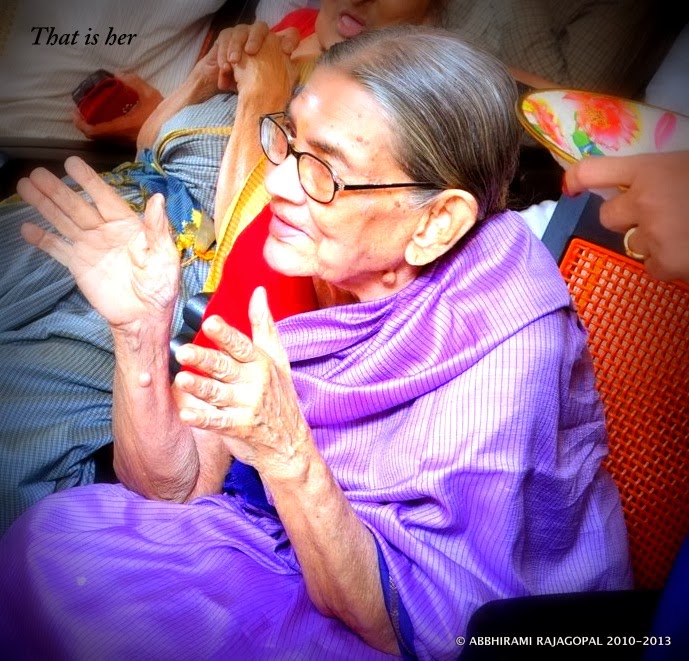
My grandma, my hero, my pretty woman (seriously no kidding, she was the prettiest in my family)- decided that her children and grandchildren can take care of themselves and stopped breathing just a few days before Diwali this year. About a month ago, this time I was mid air on my way to India- almost sure gran would not make it but hoping, nevertheless, that she would.

She was at my cousin's engagement ceremony, smiling as always. No one knew what was coming...


Born in 1927 to parents who were a part of the Indian independence struggle, my grandma had an interesting childhood. My sister and I were so enamored by her life- we would sit by her and listen to her tell us stories. She always told us stories of her childhood with such fondness. It was never boring, never!

Coming from an erudite family, she was filled with dreams and aspirations. She always wanted to do more, study more, sing more, cook more, whatever she laid eyes on she gave it her best. She used to tell us (my sister and me) of the time when she would write songs on the walls of their home. She never stopped writing because writing songs made her life better,she was pretty good at it and she did it until the end of her time (in case any one who sings carnatic songs is interested, let me know- we are trying to get some of her songs recorded to honor her memory).

But at a young age of 16, everything she ever dreamed of doing and becoming was quashed when she married a guy who did not care to provide for the family, was constantly suspicious of whatever she did and hit her for his own shortcomings.

When her 4th child was just 13 days old, she was out on the streets. Thankfully, her parents and brothers were all kind enough to take 4 little children and my grandma under their wings. Sure no one thought the 4 children were going to make it, no one thought my grandma would make it- but they all did. And here I am writing about it, writing to say how honored I am to be a part of this family- the family that makes it despite the odds.

For women in an abusive relation, the women who think they cannot make it -if my grandma and her children can make it in the 1960s India, you sure can. Believe in humanity and the kindness of strangers. My grandma always did. She used to tell us her life stories which always ended in strangers showing up when she needed the most help or even just a few comforting words. She truly believed that such strangers were God sent.

There will be things that you would never forget and there will, most definitely be regrets. Her only life-long contrition was that she had not done enough for her children- no one who knows her or her children would ever say that though.

Her two favorite குறள் (Thirukkural, a two line short poetic verse penned by the greatest Tamil scholar and philosopher Valluvar) with crude English translations

அன்பிலார் எல்லாம் தமக்குறியர், அன்புடையார் என்பும்  உரியர் பிறர்க்கு  

Those who are not loving (or loveless) have only themselves, but those who spread the love, even their bones belong to everyone

தீயினால் சுட்ட புண் உள்ளாறும் , ஆறாதே நாவினால் சுட்ட வடு

Burn injuries will heal, but hurt caused by your tongue (your words) will not heal

All those times when we were happy together, cried together, when we fought for no particular reason and laughed for no particular reason- all those times will be missed.

You taught me to be kind and honest, to always tell the truth, to never stop learning, to respect nature and to always follow my heart.

Love you forever...

Sunday, September 22

Phew- 3 more to go...

Reading Challenges- an update

 
Updates on the Color coded challenge

1. A book with "Blue" or any shade of Blue (Turquoise, Aquamarine, Navy, etc) in the title- Blue plate special by Kate Christensen

2. A book with "Red" or any shade of Red (Scarlet, Crimson, Burgandy, etc) in the title-
Red Badge of Courage by Stephen Crane
3. A book with "Yellow" or any shade of Yellow (Gold, Lemon, Maize, etc.) in the title
4. A book with "Green" or any shade of Green (Emerald, Lime, Jade, etc) in the title.
5. A book with "Brown" or any shade of Brown (Tan, Chocolate, Beige, etc) in the title- 
The Poisoned Chocolates Case By Anthony Berkeley

6. A book with "Black" or any shade of Black (Jet, Ebony, Charcoal, etc) in the title-  
The Black Cat by Martha Grimes
7. A book with "White" or any shade of White (Ivory, Eggshell, Cream, etc) in the title.
The Ivory Trail by Talbot Mundy


8. A book with any other color in the title (Purple, Orange, Silver, Pink, Magneta, etc.)-
Domestic Violets by Matthew Norman
9. A book with a word that implies color (Rainbow, Polka-dot, Plaid, Paisley, Stripe, etc.)


BLUE PLATE SPECIAL

This past weekend, traveling from Houston to Kansas city- I managed to read Blue plate Special, a memoir by Kate Christensen. I have not read any of her other books. In this book she is quite candid about her own life- from her childhood through to her 50s.

At times it felt wrong reading about someone's intimate private life especially one which involves a lot of troubled periods but then I thought to myself "she wants us to read about it- otherwise why would she write a memoir". Despite all her/their tribulations, she managed to do well for herself and so did the rest of her family.

Food is not the subject but it very well could have been- she intricately weaves it in with her own life story.

The name "Blue Plate Special" comes from when her mom who called her meals blue plate specials. There are some interesting recipes in there as well. I could not get to try them- it is quite a popular book and it was on hold for some one else :)

Friday, August 2

@ 333031


Picture this- 16 years old- young, naive, quiet, adorned in baggy clothes and a pair of shell frame glasses- that was me...

Anyway I did not realize that my room in Meera Bhawan was going to be my own little corner in this wide world when I got the BITS, Pilani application form from a friend who did not want it anymore (shall we say my mom and I were at the right place at the right time).

The day my mom dropped me off- I was literally in tears- no don't go ma, I said to her. She smiled and the smile meant "you are going to be just fine dear". I will not deny it but I was homesick for a good part of the 1st year- it was difficult what with all those hormones, new surroundings, new faces from all over the country. I will take the song "Mahan Gandhiye mahan" to my grave (this was how I was ragged- you have to sing "mahan gandhiye mahan" and dance to it as well, freshie)

Here is  a link for anyone who cares.

But it all soon began to change and I began to love every moment of it so much so that those long summers at home were quite boring and I wanted to get back to Pilani as soon as I possibly could. I especially could not wait to get in the train with my friends and sing "Mustafa, mustafa" as we would near Delhi station. The bus/ sumo rides from Delhi was also immensely fun despite a large number of eyes staring straight at a bunch of crazy teenage girls.

Macchi, sing  mustafa mustafa once for me will you? :)

We ate together, laughed together. cried together, danced together (especially after fun movie nights- remember this one time when 24 of us went to watch "Yes Boss") slept together, gossiped together, passed judgement on some, fought with a few (especially when we had to chose our wings/ hostel blocks as seniors). Friendships were made and sealed for life. Crushes, well some of them, went on to become something while others remained just what they were, a crush.

I was the thatha who rode a paal karan cycle (a.k.a I was the grandfather who rode a tall milkman bicycle).

Date nights at C'not, deliberately avoiding Shiv-G (wondering about the poor couple who chose to hang out at Shiv-G in the dark), quite evenings at the Mandir.

I liked mess food (there I said it!)- most of it anyway but there was also Annapurna's onion masala dosa and Blue Moon milk shakes. I liked chatting up those mess bhaiyas and pappuji at sky (all those "pappu account mein dal thena"/ pappu, charge it to my account).

I am not the social type but BITS brought out some of the social in me...thanks to my roommates (1st year in an expansive room with Priya and 2nd year with Goms who would set her alarms in totally random places) and other lovely friends.

A few of them helped me through my toughest times (and I hope they know that I am there for them)

Is that enough psenti for you guys- now go on...go do something useful!

Take care.

(Image source: careers 360)

Wednesday, July 17

Why not ban smoking at Miller Theater?


Imagine a hot summer evening with air that is already heavy and humid- cigarette smoke on top of that, even the most insensitive of us cannot handle it.

Take for example the first weekend of Houston Symphony concert when there are literally thousands of people in the theater- among whom is also the sensitive population that includes children, the elderly and patients perhaps (given that the theater is in the med center). On such days I wonder- why not ban smoking at all of Miller Theater (right now smoking is banned only in the seating area and not on the hill or around it)? I have seen parents smoke around their children and if they want to put their child in harm's way by smoking in the privacy of their homes-well then it is their problem. But when it comes to city property I think it is a whole different story and it is the government's responsibility that vulnerable people are protected.
 
It has been long established beyond doubt that smoking is harmful for the person who smokes and for the people who inhale the smoke.You can argue all you want. You can invoke priavcy, my body- my right (women folk- this is not for you, your body is not your right apparently- well that is a story for another day), or whatever else you can think of- but the evidence against smoking is pretty STRONG and it is about the collective good of the community.

 I must add though- I find it quite interesting that there is quite a large number of health care workers who smoke in the Houston med center area (I could not find any statistics on this).

Read more about the harmful effects of smoking here
Read more about environmental tobacco smoke here

Tuesday, July 2

The postdoc paradox

Where do I see myself in 5 years...

In my view, those who can answer this question, even with a broader intent, are the ones who succeed.

This is a question that has been playing over and over in my head for a few days, now that my love of research is dwindling to the point that there are times when I downright unhappy. This metamorphosis was a long time coming and it does pain me- because all said and done I am a bloody good scientist!

So why did you do a PhD then, you ask? Well, back in those days a) I could not be pulled away from the bench (no sir not for any reason); b) I would obsess about it; c) I would talk incessantly about it and d) most of all I was extremely passionate about it (Note the choice of past tense).

Those who have known me for a while now would nod in disbelief if I tell them that I am thinking about quitting research. Better believe it guys!

To me the biggest problem is that I would probably either be one among many scientists who are just a-okay or I would be a complete failure (which is where I am headed right now- given that nothing has been working the last few years). While the fear of failure does not stop me from doing what I like doing best, fear of being one among many does (arrogant you say- what is wrong with a bit of professional arrogance, I ask?). So it is mostly a personal decision.

Interestingly, I am seeing this disconnect between real-life and the imaginary job market situation (all of us postdocs finding a cushy tenure-track position). Most of us have been drilled into our heads that there is no job better than academia on planet earth (I might agree to this to a certain degree). In reality, even if you pass a certain threshold and enter the top echelons of postdocs (wildly successful ones-the stars), there is still no guarantee that you will find that dream job (at that level how are the search committee members going to decide anyway- think about it).

I was taken by surprise when it dawned on me that most of my fellow postdocs do not have a plan B. But what happens when you do not get into academia- what choices does one you have? Some people just moan and moan, while few others find an industry position. But this is where everything goes haywire- everyone including the postdocs, the Universities, the PIs throw their hands up in the air as though the world is nearing its end.


Paula_Stephan_Biological_Sciences_PhDs.PNG
Graph generated by Paula Stephan of Georgia State University
Source: Atlantic

A 2009 NSF survey found that only 14% of lifescience PhD land the most-coveted, oh-so-glamorous tenure track positions. The plan B pharma jobs are also on the decline (I mean who is to blame given the global economy madness). It is time PIs and institutions started to give this a great deal of thought to come up with ways to help the postdocs out (after all you are our mentors).

If you are a great researcher who is still passionate about research after 4 yrs of undergrad, 6 yrs of grad school and 5-10 yrs of postdoc - by all means academia is for you. But if you being to have slightest of doubts- I say prepare for the eventuality and be smart about the decisions you make (towards end of grad school) that will land you yet another great job ( I was anything but smart about it).


Other references
Washington Post 
Bruce Alberts article